


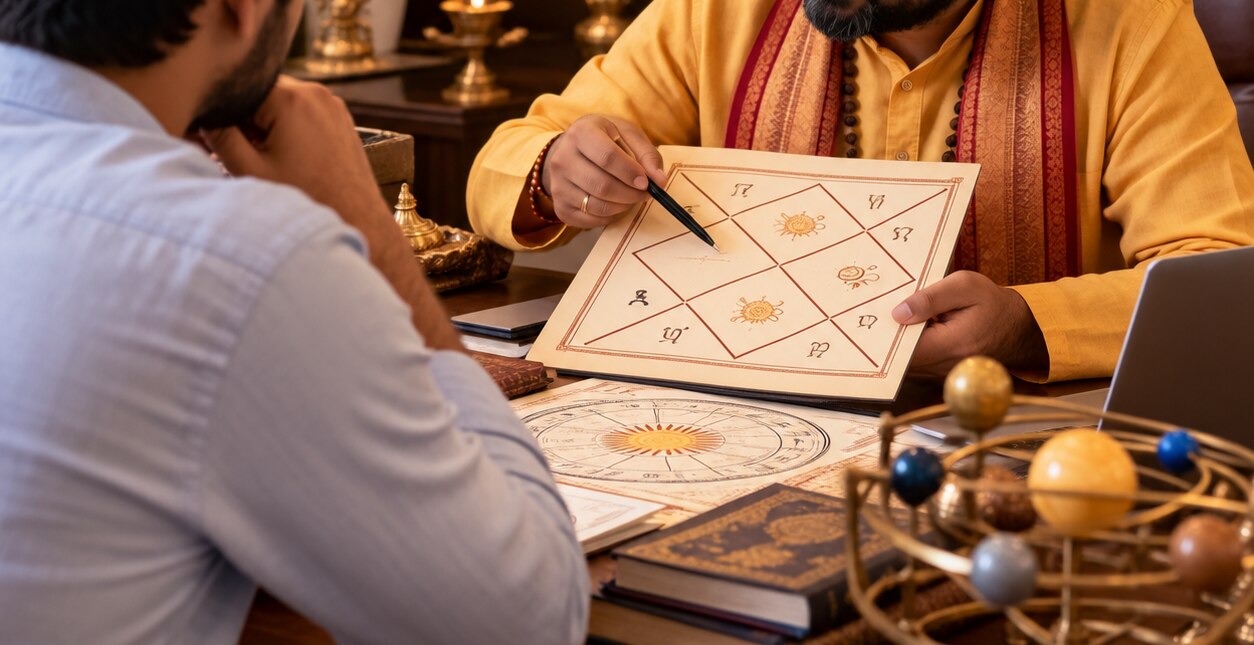
A birth chart is not a Sun-sign label: it is a time-and-location calculation involving the Ascendant, houses, planets, signs, Nakshatras, and aspects. By the end, you will know how a Vedic chart is constructed, how to read its main layers in sequence, and how to judge a consultation without treating symbolic guidance as a substitute for qualified professional advice.
Key takeaways
- Use exact birth time, date, and birthplace to construct a Kundli.
- Read houses, signs, Grahas, Nakshatras, and Drishti as an integrated system.
- Compare the Rashi, Navamsa, Dashamsa, Dashas, and current transits.
- Use astrological guidance alongside practical evidence for important decisions.
How is a Vedic birth chart constructed from your birth details?
A Vedic birth chart is a calculated map of the sky at the moment and place of birth. A Janam Kundli, also called a Kundli, uses:
- Your birth date, which fixes the Sun, Moon, and planetary positions for that day.
- Your exact local birth time, including the correct time zone and daylight-saving adjustment.
- Your birthplace, whose latitude and longitude determine local sidereal time, the houses, and the Lagna or Ascendant.
The calculation places the planets against the sidereal zodiac. The Lagna marks the eastern horizon and starts the first house; the remaining houses follow from that point. The Moon’s exact longitude also identifies its Nakshatra and pada, which can influence the traditional starting point of a dasha.
A five- or ten-minute error matters most when the Ascendant is near a sign boundary. It can change the Lagna, house cusps, and placements in divisional charts, so house-based conclusions may change even when the planets move only slightly.
Ask which settings produced the chart:
- Ayanamsha used for the sidereal zodiac
- Mean or true lunar nodes for Rahu and Ketu
- House system
- Ephemeris and birth-time rounding rule
These details explain why two astrologers can produce different versions of the same Kundli.
What do the 12 houses, nine Grahas, signs, Nakshatras, and Drishti represent?
A chart has several layers. The 12 houses in Vedic astrology show life areas, while the 12 zodiac signs describe how those areas operate. The 27 Nakshatras and padas add finer psychological and timing detail. Drishti means a planet’s aspect, or the houses and planets it influences from its position.
- First house: identity, body, appearance, vitality, and direction.
- Second house: speech, family values, food, savings, and possessions.
- Third house: courage, skills, communication, siblings, and short journeys.
- Fourth house: home, mother, emotional security, education, and property.
- Fifth house: learning, creativity, children, romance, and judgment.
- Sixth house: work, service, health challenges, debts, and competition.
- Seventh house: marriage, partnerships, contracts, and public dealings.
- Eighth house: shared resources, upheaval, inheritance, research, and secrecy.
- Ninth house: teachers, faith, higher learning, ethics, and long travel.
- Tenth house: career, authority, reputation, and visible duties.
- Eleventh house: income, networks, gains, ambitions, and elder siblings.
- Twelfth house: expenses, sleep, isolation, foreign settings, and release.
The nine planets or Grahas carry natural themes:
- Sun: selfhood, authority, confidence, father, and purpose.
- Moon: feelings, mind, habits, mother, and public response.
- Mars: energy, courage, conflict, tools, and initiative.
- Mercury: speech, analysis, trade, learning, and adaptability.
- Jupiter: wisdom, teachers, children, prosperity, and meaning.
- Venus: love, art, comfort, pleasure, and agreements.
- Saturn: discipline, labour, delay, responsibility, and endurance.
- Rahu: appetite, ambition, disruption, and foreign or unusual paths.
- Ketu: detachment, insight, separation, and spiritual investigation.
Rahu and Ketu are lunar nodes, not physical planets; their Drishti and results depend on chart context.
In what order should an astrologer interpret a birth chart?
Begin with the Lagna, because it sets the house framework for the entire Kundli. Then judge the Lagna lord: its sign, house, planetary strength, and relationship with benefic or difficult influences show how the chart’s central themes operate.
1. Mark the occupied houses and note which Grahas sit there. A planet gives results through its natural meaning and the house it occupies, so do not read either factor alone.
2. Identify each house lord and locate it elsewhere in the chart. A house lord’s placement, aspects, conjunctions, and connection with other house lords often matter more than an empty-house assumption.
3. Assess planetary strength and planetary dignity. Check sign placement, exaltation, debilitation, own sign, friendly or hostile sign, Shadbala where calculated, and support from relevant divisional charts.
4. Examine Drishti and conjunctions next. These links can modify, strengthen, obstruct, or redirect a planet’s results; count the planets involved rather than treating one aspect as decisive.
5. Check combustion and retrograde planets separately. Combustion describes close proximity to the Sun, while retrograde motion changes interpretive emphasis; neither automatically makes a planet harmful or useless.
6. Evaluate named yogas only after these checks. A yoga such as Raja Yoga or Dhana Yoga requires the right house ownership, dignity, connections, and operating Dasha. Confirm its promise through timing, divisional support, and transits before offering a likelihood—not a guaranteed prediction.
How do Rashi, Navamsa, Dashamsa, Dashas, and transits work together?
A Rashi chart is the main birth map: it shows the Lagna, houses, signs, Grahas, and Drishti from the calculated birth moment. Divisional charts refine specific subjects; they do not replace the Rashi chart or represent separately observed sky positions.
- Navamsa D9 divides each sign into nine sections of 3°20′. Use it alongside the Rashi chart to examine marriage, dharma, and a planet’s deeper strength or status.
- Dashamsa D10 focuses on career, professional responsibilities, authority, and visible work outcomes. Judge it against the relevant houses and planets in the Rashi chart.
- The Moon chart places the Moon as the first house. It highlights emotional experience, mental response, and how circumstances are felt rather than replacing the Ascendant-based reading.
- Other divisional charts address narrower subjects, such as children, property, siblings, or spiritual development. Use the chart that matches the question, not every division at once.
Timing comes from combining the natal promise with periods and movement. The Vimshottari Dasha system begins from the Moon’s birth Nakshatra and assigns a planetary sequence; its Mahadasha gives the broad chapter, while the Antardasha narrows the active theme. The starting point depends on the Moon’s exact longitude and the elapsed portion of its Nakshatra.
Gochara transits compare current planetary positions with the natal Rashi chart and Moon chart. A transit can activate a period, create pressure, or supply opportunity, but it does not guarantee an event. A Sun-sign forecast alone omits this chart-specific timing method.
How can you use a Vedic astrology consultation responsibly in Noida?
Ask for a written interpretation, not a fixed prediction. A responsible Vedic astrologer in Noida will state the birth date, local birth time, birthplace, ayanamsha, node convention, house system, and ephemeris used. A five- or ten-minute time error can shift the Lagna, house cusps, or divisional-chart placements.
1. Confirm the calculation before discussing outcomes. Ask whether the recorded birth time is exact, rounded, or uncertain, and request the Rashi chart, relevant divisional charts, dasha periods, and transit dates.
2. Require reasoning for each conclusion. Ask how house ownership, dignity, aspects, conjunctions, and dasha timing support a claim; a named yoga is not a guaranteed event.
3. Separate symbolism from evidence. Astrology and scientific evidence do not establish that natal planetary positions cause or reliably predict illness, personality, compatibility, career results, elections, or future events.
4. Turn advice into a testable, practical choice. Compare it with your budget, documents, professional recommendations, and measurable risks instead of treating a prediction as proof.
A birth chart consultation with BADAL DE KISMAT can support reflection about priorities, habits, or timing while leaving decisions to qualified experts. Use a doctor for symptoms or pregnancy care, a licensed mental-health professional for distress, a lawyer for disputes, a regulated adviser for investments, and official civic sources for elections.
Treat astrological remedies and gemstones as cultural or spiritual practices, not medical treatment; gemstones can cost money, irritate skin, or delay necessary care.
Frequently asked questions
How is a Vedic birth chart constructed from your birth details?
An astrologer uses your birth date, exact birth time, and birthplace to calculate the planetary positions, Ascendant, houses, signs, Nakshatras, and divisional charts in your Janam Kundli.
What do the 12 houses, nine Grahas, signs, Nakshatras, and Drishti represent?
The 12 houses describe life areas, the nine Grahas represent active forces, signs describe expression, Nakshatras add finer lunar divisions, and Drishti refers to planetary aspects.
In what order should an astrologer interpret a birth chart?
Start with the Ascendant and its lord, assess house lords and occupants, examine planetary strength and condition, then add Nakshatras, aspects, yogas, divisional charts, Dashas, and transits.
How do Rashi, Navamsa, Dashamsa, Dashas, and transits work together?
The Rashi chart provides the main framework, Navamsa helps assess deeper planetary and relationship themes, Dashamsa focuses on career, Dashas indicate timing periods, and transits show current planetary influences.
How can you use a Vedic astrology consultation responsibly in Noida?
Use a consultation to frame questions and timing options, provide accurate birth details, request clear reasoning, protect your personal information, and combine astrological advice with financial, medical, legal, or professional guidance when needed.